
Bombay Ferry Wharf – Bhau-cha-Dhakka
Bombay’s transformation from a group of relatively undeveloped islands into one of the most important commercial cities of the British Empire is a story of vision, enterprise and extraordinary determination. Among those who contributed to this transformation was a remarkable individual from our own community: Lakshman Harichandraji Ajinkya, popularly known as Bhau.
Today, the name Bhau-cha-Dhakka is familiar to generations of Mumbaikars. Yet the story behind this historic waterfront and the man responsible for its creation is not widely known.
Bombay – From a Barren Island to a Royal City
Bombay’s transformation was acknowledged in the address of welcome presented by the city’s leading citizens to His Royal Highness the Prince of Wales, later King Edward VII, during his visit to Bombay in November 1875. He had come to lay the foundation stone of Princess Dock, now known as Indira Dock.
“From a barren rock, whose only wealth consisted in coconuts and dried fish, whose scanty population of 10,000 souls paid a total revenue to the state of not more than £6,000 a year … she has blossomed into a fair and wholesome city in rank next to London …”
Address of Welcome to the Prince of Wales, November 1875The address went on to describe the growth of Bombay’s revenue and overseas commerce, highlighting the extraordinary transformation that had taken place over the preceding two centuries.
The foundations of this transformation had been laid much earlier by men of vision, enterprise and determination.
The marriage treaty between King Charles II of England and Princess Catherine of Portugal, followed by the transfer of Bombay from the Crown to the East India Company, described the territory as a port. It was in this capacity that Bombay developed over the following centuries.
Bombay’s Growing Maritime Importance
By the beginning of the nineteenth century, Bombay had acquired a strong political and commercial position in Western India. The western coastline, extending towards Kandla in the north and the Canara and Calicut coasts in the south, had come under British protection.
This contributed to the rapid expansion of Bombay and its maritime trade.
Boats and country crafts, including vessels of approximately 300 tons, carried goods from Bombay to Persia, Bussra, Muscat and neighbouring regions. Their cargo included cotton goods, pepper, silk and precious stones. Small frigates also operated from the harbour.
The Wadia family, led by Lowji Nusservanji Wadia, who had migrated from Surat, played a pioneering role in shipbuilding. They constructed wooden ships in Bombay and contributed significantly to its maritime development.
The Need for Better Dock Facilities
Bombay’s first dry dock, intended for ship repairs and maintenance, came into operation in 1750 on the site of the present Government Dockyard. However, it was small and could accommodate only two ships at a time.
The need for larger wet docks became increasingly apparent as maritime trade expanded. Ships required adequate space for berthing, loading and unloading cargo and embarking passengers.
Until 1835, Bombay did not have a properly constructed wharf or bunder for handling either goods or passengers. Much of the loading and unloading was carried out in the harbour streams.
It was only in 1839 that the first enclosed wet dock was constructed.
In 1832–33, the Government began leasing portions of land along Bombay’s harbour frontage to private individuals. These arrangements included certain reclamation rights for the construction of wet docks, wharfs and basins.
The Opportunity That Bhau Recognised
The first native to seize this opportunity was Lakshman Harichandraji Ajinkya, popularly known as Bhau or Bhausaheb, meaning “Big Brother”.
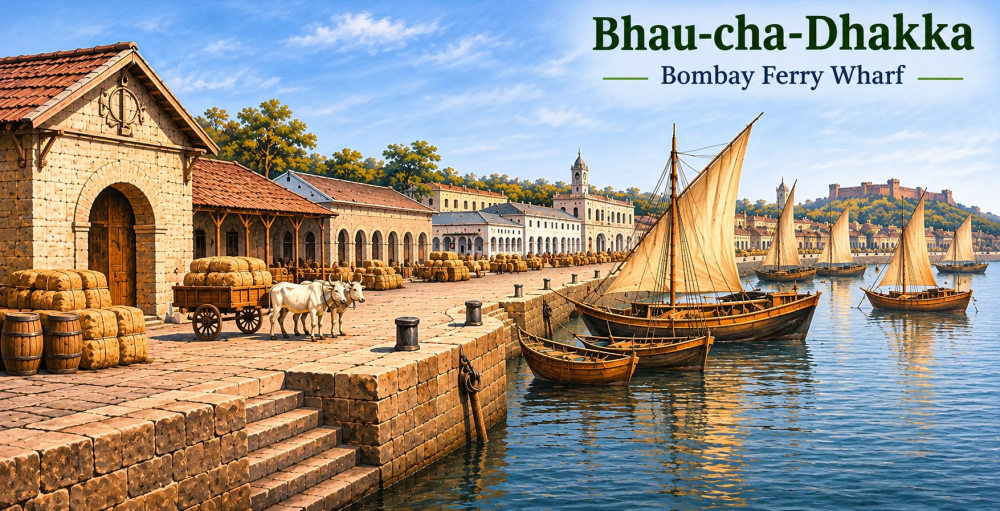
The Claire and Carnac Bunders were among the earliest projects undertaken at Bombay Harbour by L.H. Ajinkya. The present Ferry Wharf comprises the historic Carnac and Claire bunders and is popularly known as Bhau-cha-Dhakka.
Bhau-cha-Dhakka derives its name from the man who conceived and constructed this important waterfront facility. The name is a lasting recognition of Lakshman Harichandraji Ajinkya’s contribution to Bombay.
Who Was Lakshman Harichandraji Ajinkya?
Lakshman Harichandraji Ajinkya was a well-to-do member of the Pathare Prabhu community. Born in 1789, he was popularly known as Bhau or Bhausaheb.
Bhau had family property in Naigaon, Parel, and possessed Kothi rights in the villages of Andheri, Akurli and Malad.
At the time, he was still employed as a chief clerk in a gun carriage factory at Colaba. Originally from Uran, he had personally experienced the difficulties of travelling to Bombay.
His own experiences made him realise the importance of providing safe and convenient landing facilities for people travelling from the Konkan region to Bombay.
The Ambitious Proposal of 1836
On 17th December 1836, Bhau submitted an application to W.C. Bruce, the then Collector of Bombay, seeking permission to reclaim a portion of land covered by the sea along the harbour frontage.
The proposed area extended from Chinch Bunder to Masjid Bunder in the north, and from Masjid Bunder towards the Meat Market, now Mahatma Phule Mandai, in the south. It also covered the waterfront area extending from Doongri Cooly Street towards the east.
His proposal involved reclaiming land, removing obstructions to navigation and constructing facilities that would serve both commercial interests and the travelling public.
The then Collector, Sir Robert Grant, recommended the proposal to the Governor. He recognised that the improvements would serve the public interest, enlarge and beautify the city and help curb smuggling activities from the Gulf countries, which the Government found difficult to control.
The Government consequently granted Bhau permission to reclaim the land and construct basins and roads.
Reclaiming Land from the Sea
The reclamation work commenced in 1837. Bhau demonstrated considerable ingenuity in carrying out this massive undertaking economically.
Instead of depending entirely on expensive materials, he used the city’s garbage, rubble and waste material for reclamation. This helped reduce the overall cost of the project.
By 1839, the work from Chinch Bunder to Masjid Bunder was almost complete, while the extension southwards towards the Meat Market was progressing.
However, the project was far from over. Bhau was about to face a fresh set of administrative and financial challenges.
New Conditions and Mounting Responsibilities
With changes in the administrative arrangements of the East India Company and the Government’s approach to Bombay’s development, the earlier sanctions granted to Bhau were revised.
He was required to sign two new lease agreements containing considerably more rigorous conditions.
His responsibilities included:
- Construction of two roads, wharfs and basins.
- Construction of drains.
- Construction of four additional roads, each with a width of forty feet.
- Provision of open spaces.
- Repair and maintenance of the roads and other infrastructure.
The entire expenditure was to be borne by Bhau. In return, he was granted monopoly rights for the free use of the reclaimed land for trading purposes for fifty years.
There was, however, a demanding condition: the entire work had to be completed within four years.
Resistance from the Neighbourhood
Bhau’s ambitious project also encountered resistance from residents of adjoining localities.
Residents of Dongri, led by one Qazi Shabuddin, attempted to obtain an injunction from the Government against the proposed improvements. Their objection was that the construction was creating a nuisance in the locality.
The account suggests that the proposed improvements would also affect their existing smuggling activities.
The residents argued that they had been living in the locality for approximately 150 years and that the construction should therefore be handed over to them.
“If so, why they were sleeping for 150 years? The entire ground under water belongs to the Government and not to them.”
Reply attributed to BhauThe Government supported Bhau’s position and permitted the work to continue.
Sir Robert Grant’s Appreciation
In 1841, Sir Robert Grant, before leaving for England on retirement, specially visited the site to inspect the improvements undertaken by Bhau.
He was extremely impressed by the progress and recorded his appreciation in his notes:
“I was surprised at the progress which has been made in magnificent useful work, the whole of the retaining wall has been completed and the basin for receiving number of boats has been prepared. I cannot too highly praise the energy, and public spirit of Lakshman in undertaking the work of this magnitude.”
Sir Robert Grant, 1841Sir Grant was sufficiently impressed to provide Bhau with a loan of Rs. 1.5 lakhs before departing for England.
Financial Pressures and Further Obstacles
The financial arrangements surrounding the loan created additional difficulties for Bhau.
To secure repayment, the Government solicitor imposed a penalty bond carrying compound interest at six per cent per annum. The loan was to be repaid within eight years.
Failure to repay would result in the Government taking over the entire constructed work and adjusting its cost against the value of Bhau’s personal assets.
With little alternative, Bhau signed the penalty bond and mortgaged his properties.
Further objections were raised by Dongri residents, who complained that their gullies and drains had become choked due to the reclamation work. They demanded that their drains be connected to the drainage system constructed by Bhau, at his expense.
Under Government instructions, Bhau accepted this additional responsibility without protest.
Changing Agreements and the Final Construction
As the work progressed, the Government solicitor continued reporting on Bhau’s construction activities. By this stage, the wharf, basins and roads had been constructed.
The revised lease deed created rights over the construction for Bhau. The solicitor subsequently recommended that the reclaimed ground be enclosed by walls, with gates across the roads to facilitate customs control.
Bhau protested that repeated revisions to the agreements were delaying the work. The Governor himself became unhappy with the frequent changes and strongly criticised the solicitor.
Nevertheless, Bhau was compelled to fortify the reclaimed ground and construct the required gates.
Despite these repeated changes, the original completion schedule remained unchanged, adding considerably to the pressure on him.
Bhau’s Legacy – What Happened to His Rights?
The historical account does not establish whether Bhau ultimately repaid the loan or what happened to his fifty-year monopoly rights.
However, his will, read in 1858, the year of his death, records that Claire and Carnac Bunder remained in his possession.
This indicates that the property continued to remain associated with Bhau for approximately twenty to twenty-two years after the commencement of the project.
A Vision Beyond His Time
Bhau’s original intention was to serve the people of the Konkan region and the business community of Bombay by providing safe landing facilities and better commercial infrastructure.
He undertook this Herculean task at a time when electricity, automobiles and steam engines were not available for such construction activities. Bullock carts were the principal means of land transport.
The period was also politically turbulent, particularly with the events surrounding the uprising of 1857.
Yet Bhau had undertaken the development of a waterfront area measuring over 75,000 square yards, with monopoly rights extending over fifty years.
His work involved reclaiming land from the sea, constructing retaining walls, building basins and wharfs, laying roads and drains, and addressing the numerous administrative and neighbourhood challenges that arose along the way.
A Landmark. A Legacy. A Forgotten Pioneer.
Today, Bhau-cha-Dhakka continues to be recognised as an important part of Mumbai’s maritime landscape. Yet the man whose vision and enterprise gave this landmark its identity is largely forgotten by succeeding generations.
Lakshman Harichandraji Ajinkya, our own Bhausaheb, undertook a monumental project that contributed to the commercial development and growth of Bombay.
His achievement deserves to be remembered not merely as a chapter in the history of a wharf, but as an enduring example of enterprise, courage, public spirit and perseverance.
It is a legacy of our community.
A legacy we must preserve and remember.
Historical Reference
Based on historical records preserved in the Department of Archives, Government of Maharashtra, as referenced in the original account.
Courtesy: Pathare Prabhuncha Itihaas
Author: Pratap M. B. Velkar