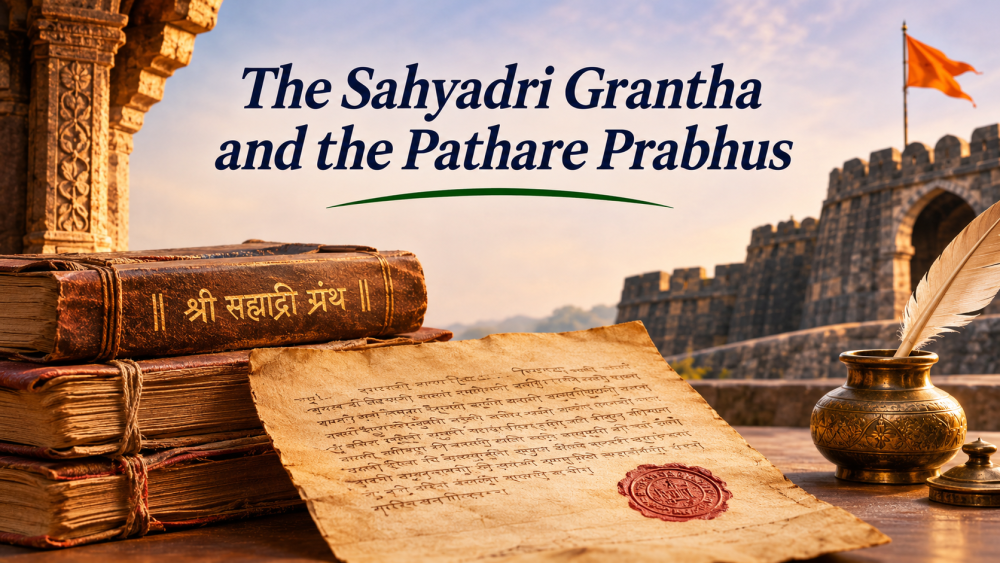
The Pattan Prabhus were unaware of any references for their surnames, gotras and their caste being Kshatriya. Hence, in the year 1648 (Marathi calendar), i.e. 1726 A.D., they requested the then Shankaracharya to give the reference for the same.
Shri Shankaracharya prepared a consent letter referencing the detailed story of the Pattan Prabhus in the chapters of “Shri Sahyadri”.
The Sahyadri Grantha and Its References
The description of the Pattan Prabhu Kshatriyas is found in the first eight chapters of the original Sahyadri Grantha. The description is composed within five hundred and ten ‘Shlokas’.
The Sahyadri Grantha had not only the consent letter of Shri Shankaracharya but also the consent letters of other Gurjar Brahmins.
Consent Letters of Shri Jagatguru
In the year 1701 (Marathi calendar), i.e. 1779 A.D., Shri Jagatguru gave the two consent letters in the Maharashtrian language to the Brahmins and the Peshwas.
Among the other letters, this letter stands fifth in importance. This letter proves the relationship between the Peshwas and the Pathare Prabhus.
This event was not as important to be mentioned in the Maratha history, but one can certainly find it in the Sahyadri Grantha.
The Dispute Over Religious Ceremonies
On behalf of the Patane Prabhus, Shri Vidyashankar Bharti wrote a letter to Shrimant Madhavrao Peshwe saying that Patane Prabhus had been living in the Sahyadri region for a long period.
The enemies of the Patane Prabhus tried to create a misconception in the minds of the Brahmins of Bombay by getting a letter from the Peshwai. But the Brahmins of Bombay ignored it and continued to perform the rituals of the Patane Prabhus.
The enemies of the Patane Prabhus then poisoned the mind of the subedar of Vasai, who ordered the Brahmins to stop the rituals of the Patane Prabhus in Mumbai and Mahim.
But the subedars of Saashti and Uran investigated this matter, rejected the letter and ordered the Brahmins to continue the rituals.
In the end, the enemies went to Pune and created a misunderstanding about Patane Prabhus in the mind of Vedmurti R. R. Ramshastri Prabune.
This led to a letter from Shri Prabune to all the Brahmins of Maharashtra, Bombay and Kelve Mahim. (The concept of Maharashtra was that of the Maratha Kingdom only.)
The letter stated that those Brahmins who went to the Patane Prabhus had been out-casted. Due to this, the rituals of the Patane Prabhus stopped.
Since the order was passed without investigation, the Pathare Prabhus requested a complete inquiry in this matter.
The Consent Number 1842
Considering the above fact, in the year 1709 (Marathi calendar), i.e. 1787, Shrimat Shankaracharya in his consent number 1842 requested Shrimant Sawai Madhavrao Peshwe, stating that Pathare Prabhu had an ancient origin and their Rajgurus were from upper caste.
The reference to this is found on the copper plates of Raja Bimba’s Era and is also mentioned in the Sahyadri Grantha.
Before sending this consent, Shrimat Shankaracharya took the approval of the Brahmins of Bombay and Mahim. The consent had the signature of sixteen highly respected Brahmins of Bombay.
The Consent Presented Before Sawai Madhavrao Peshwe
This consent letter and the goods of Pathare Prabhus were presented in the court of Sawai Madhavrao Peshwe by V.S.S.R. Ghanshyam Shastri Jadye.
The instant Shrimant Sawai Madhavrao Peshwe saw the letters, he congratulated Shri Shankarswami Jagatguru and clearly warned the enemies of Pathare Prabhus that their allegations were without any base.
He ordered all Brahmins to safely continue the rituals of the Pathare Prabhu.
But Nana Phadnavis, the political adviser of the Peshwas, disapproved this stand of Shrimant Sawai Madhavrao Peshwe.
Nana Phadnavis and the Pathare Prabhus
Nana Phadnavis had a grudge against the Pathare Prabhus.
During the Peshwe era, the Pathare Prabhus of Bombay and Kelwe Mahim were under the rule of the Portuguese.
The Pathare Prabhus harassed the local Brahmins and residents of that region by forcing them to behave according to the Portuguese sayings. Hence, the Brahmins and the other locals of the Peshwa and the Portuguese kingdoms considered the Pathare Prabhus as their rivals.
Due to the appeal of these locals, Peshwe Balaji Bajirao, alias Nanasaheb Peshwe, without giving a single thought to the laws, politics etc., time and time again sent sealed orders from Pune to all Brahmins of Maharashtra.
The orders stated that all rituals performed at the places of Pathare Prabhus must be stopped.
This hostility led to death atonement of many Pathare Prabhus.
The Struggle to Continue Religious Ceremonies
Performing marriages, thread ceremonies and other rituals became a big issue for the Pathare Prabhus. They faced this suffering for many years.
The only available solution was to surrender to Shrimat Jagatguru Shri Shankaracharya and through him pressurise the Peshwas.
Nana Phadnavis did not challenge the authority of Shrimat Jagatguru Shri Shankaracharya and this led to the culmination of this issue in the Peshwai.
The Sahyadri Grantha and Our History
The account describes the efforts made by the Pathare Prabhus to establish references for their surnames, gotras and Kshatriya identity, and to secure the continuation of their religious ceremonies.
The consent letters of Shri Shankaracharya, the correspondence with the Peshwas and the references in the Sahyadri Grantha form the central part of this historical account.
Historical Source
Courtesy: Pathare Prabhuncha Itihaas (Pratap M. B. Velkar)
Translators
Sau Meghana P. Rane
Mr. Tejas P. Rane
Mr. Amit P. Kotharé