The Arabian Tahr – A Unique Goat and Its Discoverer
One’s stay in Muscat is incomplete without spending a few hours in the study at the National Museum, situated within the Ministry of National Heritage and Culture premises in uptown Al Khuwair.
The mystique and bounty of nature that Oman represents are displayed vividly within a few hundred square metres of space. It would hardly be surprising if visitors were tempted to make repeated visits.
The Sultanate of Oman, as a whole, is unique in many ways.
Muscat itself enjoys the rare distinction of being a city with the Tropic of Cancer passing through its southern suburbs. Havana and Dhaka are also located near this imaginary line on the world map.
The Sultan Qaboos Nature Park at Al Qurm, situated between the Muscat InterContinental and the Gulf Hotels, is a place of rare beauty. A companion once ecstatically described Muscat as a city of mountains and fountains.
The Arabian Tahr – A Rare Mountain Goat
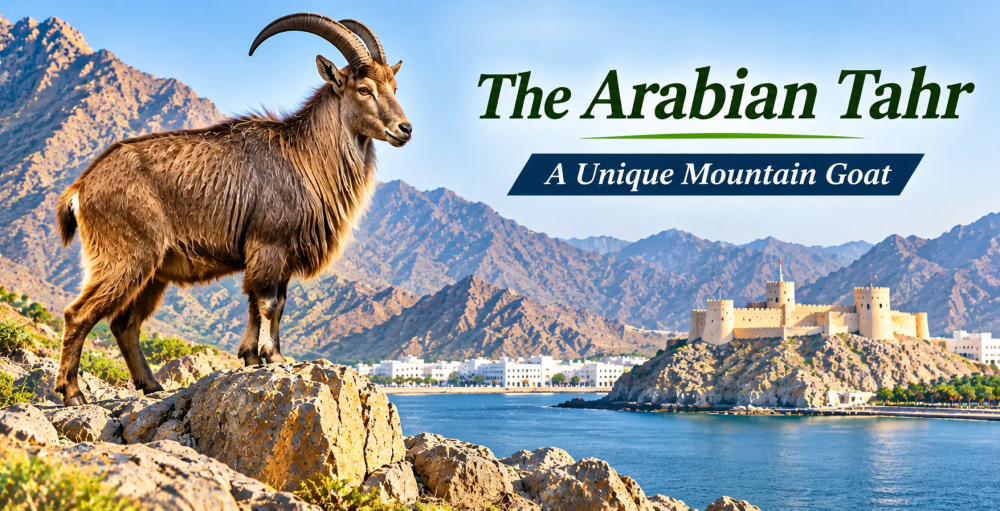
One of the most striking exhibits among the stuffed wildlife and marvels of taxidermy at the Natural History Museum is that of a rare mountain goat – the Arabian Tahr, found in Oman alone.
Its possible distant cousin is the Himalayan Tahr, known to zoologists as Hemitragus jemlahicus. In fact, the word “Tahr” has its roots in the Nepali word “Thaar”.
The Arabian Tahr is a distinctive mountain animal associated with Oman. Its scientific name, Hemitragus jayakari, commemorates the Indian doctor and naturalist Dr. A. S. Jaykar, to whom its discovery is attributed.
The discovery of the Arabian Tahr is graciously attributed to Dr. A. S. G. Jaykar in the accompanying legend at the museum. Quite fittingly, the animal has been named Hemitragus jayakari after him.
India and Oman – A Long-standing Relationship
History tells us of the close trade relations and social interaction that have existed between Oman and India over centuries.
Even today, a brand of rice produced in India is called “Maskati”, reflecting its export value and demand in Muscat in days gone by.
Indians in large numbers have, for centuries, enjoyed the friendliness and hospitality of Oman.
Yet a majority of contemporary residents may not have heard of a compatriot who spent a good part of his life in Oman, serving as a surgeon and pursuing his interests as a linguist and researcher towards the end of the nineteenth century.
Dr. A. S. Jaykar – A Remarkable Indian in Oman
Who would have expected a Bombay-born doctor, without the basic knowledge of Arabic language and script, to travel to Oman over a century ago and compile a collection of Arabic proverbs prevalent in the country?
That speaks of the sheer grit and determination Dr. Jaykar was made of.
Born in 1844, Atmaram Sadashiv Grandin Jaykar married Dwarkabai Putoba at the age of fifteen. This, however, did not deter his educational pursuits, which took him all the way to England.
Education and Early Medical Career
Dr. Jaykar studied at Grant Medical College between 1862 and 1867. He qualified to practise medicine and surgery from the United Kingdom’s Royal College of Physicians and Royal College of Surgeons respectively. He soon passed the competitive Indian Medical Service examination there.
Following this, Jaykar studied for five months at the Royal Victoria College’s Army Medical School at Netley, securing eighth place out of twelve.
In April 1868, he arrived in Bombay and took over as Assistant Surgeon in the northern district of the Bombay Province, then known as the Bombay Presidency.
Beginning of His Long Association with Muscat
The fruitful phase of Dr. Jaykar’s life began when he took up a position as a civil servant in Muscat in January 1873.
Perhaps owing to the new environment and weather conditions, he had to be on sick leave between July 1874 and May 1875.
Yet, during his illness and recuperation, he undertook an important piece of research titled “The Medical Topography of Mascat”.
This work saw the light of day in 1876–77 in the Administration Reports of the Persian Gulf Political Residency and Mascat Political Agency in London. It later earned the distinction of a ten-volume reprint in archival editions.
Even during a period of illness and recovery, Dr. Jaykar continued his intellectual pursuits. His study of Muscat’s medical topography became an important early contribution to the documented understanding of the region.
Service to the Sultan of Muscat
Rising to the rank of Surgeon Major in 1880, Dr. Jaykar, for the first time, stood in for the British Political Agent, Major Grant, during the latter’s vacation in July.
In November 1881, although only for a few days, he had the privilege of medically attending the then ruler, Sultan Turki bin Said bin Sultan Al Said.
He also treated the ruler during an illness in February 1884.
Over the years, Dr. Jaykar officiated during the Political Agent’s leave vacancies. He attained the rank of Lieutenant Colonel in 1892. The position of Political Agent was broadly equivalent to that of a political ambassador.
The Linguist and Researcher
By this time, Dr. Jaykar had travelled extensively throughout Oman and learnt the Arabic script and language.
He undertook an extraordinary project: compiling Omani proverbs, together with special notes on their origins, references to their context, their relationship with social norms and living conditions of the time, and their English equivalents.
This collection reflects the doctor’s remarkable command over both English and Arabic. It also demonstrates the enormous and painstaking effort he devoted to folklore research.
Preserving Oman’s Oral Heritage
Between 1900 and 1903, Dr. Jaykar’s collection of Omani proverbs became an important record of the country’s language, culture and social customs.
The Bombay Branch of the Royal Asiatic Society published the collection in its journal.
A few years ago, The Oleander Press of London brought out a reprint of this collection, while Oman’s Ministry of National Heritage and Culture also published an Arabic version.
Dr. Jaykar’s work went beyond medicine. By recording Omani proverbs, their meanings and their social contexts, he helped preserve a valuable part of the country’s oral and cultural heritage.
A Life of Exploration and Discovery
After a meritorious service of approximately 27 years in Muscat, Dr. Jaykar retired in May 1900.
His passion for travel, adventure and research, which in retrospect may appear almost unimaginable in the absence of modern amenities, roads and communication facilities, will always remain memorable.
No less significant was his discovery of Oman’s unique mountain goat, the Arabian Tahr.
A Fitting Tribute from Oman
The Government of Oman has taken great care in preserving the only clan of Arabian Tahr (Hemitragus jayakari) at the Jabal Aswad Sanctuary.
There could hardly be a more fitting tribute to the man to whom the discovery of this remarkable animal is attributed.
The naming of the species after Dr. Jaykar stands as a lasting recognition of his contribution to natural history and his association with Oman.
A Legacy Beyond Medicine
Lt. Col. Dr. Atmaram Sadashiv Grandin Jaykar was much more than a medical officer. He was a scholar, linguist, traveller and researcher whose curiosity took him far beyond the boundaries of his profession.
From Bombay to Muscat, from medical research to the study of Arabic proverbs, and from public service to the discovery of the Arabian Tahr, his life reflects an extraordinary spirit of learning and exploration.
A scholar who preserved its traditions.
And a discoverer whose name lives on in the Arabian Tahr.
Historical Reference
Courtesy: Pathare Prabhuncha Itihaas
Author: Pratap M. B. Velkar